NH Food Bank Reports Child Food Insecurity Has Increased By More Than 6% in the Last Year
FOR IMMEDIATE RELEASE
Contact Information
Micaela Whalen
New Hampshire Food Bank
603.669.9725 ext. 1246
micaela.whalen@nhfoodbank.org
NH Food Bank Reports Child Food Insecurity Has Increased By More Than 6% in the Last Year
Feeding America reports one in nine NH residents, including one in six NH children, experience food insecurity, underscoring the need for continued community support
Read news coverage on WMUR, NH Bulletin, Keene Sentinel, and the NH Union Leader
MANCHESTER, N.H. — A new report from Feeding America highlights a concerning rise in food insecurity across New Hampshire, particularly among children. According to the 2026 Map the Meal Gap study, child food insecurity increased by 6% year-over-year, climbing from 36,160 children in the 2025 report to 38,430 this year. Because the comprehensive federal surveys required for this study involve a standard two-year data processing lag, the newly published 2026 report reflects the reality families faced in 2024.
The overall food insecurity rate has also grown, with the latest data showing 11.2% of all New Hampshire residents lack consistent access to adequate food, up from 10.7% in the previous report. In response to these rising numbers, the New Hampshire Food Bank, a program of Catholic Charities New Hampshire, is urging Granite Staters to act and help support the local families who do not know where their next meal will come from.
“The Map the Meal Gap report confirms what we see every day: the struggle to put food on the table is a growing reality in every corner of the Granite State,” said Elsy Cipriani, Executive Director of the New Hampshire Food Bank. “What is most heartbreaking is the toll this takes on our children. As the state’s only food bank, we are working tirelessly to distribute fresh, nutritious food through our network of over 400 partner agencies. But we cannot do this alone. We are calling on our community to stand with us so we can reach our ultimate goal of eliminating hunger in New Hampshire.”
The following statistics reflect New Hampshire food insecurity rates by county, according to the 2026 Feeding America report:
- Belknap – 2026: Overall: 10.6%; Child: 15.8%
- Carroll – 2026: Overall: 11.1%; Child: 17.3%
- Cheshire – 2026: Overall: 11.5%; Child: 16.3%
- Coös – 2026: Overall: 15.4%; Child: 22.1%
- Grafton – 2026: Overall: 11.8%; Child: 16.2%
- Hillsborough – 2026: Overall: 11.1%; Child: 16.3%
- Merrimack – 2026: Overall: 11%; Child: 15%
- Rockingham – 2026: Overall: 8.8%; Child: 11.6%
- Strafford – 2026: Overall: 11.7%; Child: 16.6%
- Sullivan – 2026: Overall: 12.3%; Child: 18.3%
The following statistics reflect New Hampshire food insecurity rates by county, according to the 2025 Feeding America report:
- Belknap – 2025: Overall: 11.2%; Child: 16.1%
- Carroll – 2025: Overall: 10.9%; Child: 17.3%
- Cheshire – 2025: Overall: 11.6%; Child: 16.7%
- Coös – 2025: Overall: 14.3%; Child: 21.6%
- Grafton – 2025: Overall: 11.5%; Child: 15.7%
- Hillsborough – 2025: Overall: 10.3%; Child: 14.1%
- Merrimack – 2025: Overall: 10.5%; Child: 13.7%
- Rockingham – 2025: Overall: 8.9%; Child: 10.8%
- Strafford – 2025: Overall: 11.3%; Child: 14.1%
- Sullivan – 2025: Overall: 11.9%; Child: 16.9%
The 2026 Map the Meal report (2024 data) shows that while food insecurity rates remained relatively stable in some counties, in seven out of ten counties the state experienced measurable increases. The most significant increases were seen in Hillsborough, Strafford, Merrimack and Sullivan counties, especially among children. Strafford County’s child food insecurity rate increased from 14.3% to 16.6%, while Hillsborough County rose from 14.3% to 16.3%. Merrimack and Sullivan counties also saw notable increases in child food insecurity, reaching 15.0% and 18.3%, respectively.
To address the growing demand for healthy and nutritious options, the Food Bank is significantly expanding its fresh rescue operations, increasing deliveries to remote communities, providing more fresh produce and protein through Mobile Food Pantries, and supporting partner agencies with capacity-building grants.
In 2025, the New Hampshire Food Bank distributed more than 20 million pounds of food to its more than 400 partner agencies statewide. In addition to distributing food to all corners of the state, the New Hampshire Food Bank provides an array of programming designed to address the root causes of hunger, including Culinary Job Training, Mobile Food Pantries, NH Feeding NH, the Nutrition Pantry Program, and SNAP Outreach and Application Assistance, among many others.
Residents looking to support the New Hampshire Food Bank can:
- Donate: for every $1 donated, 93 cents directly supports New Hampshire Food Bank’s programming
- Volunteer: visit nhfoodbank.org to learn more about volunteer opportunities
- Host a Food Drive: host a food drive or consider donating some of the New Hampshire Food Bank’s “Most Needed Items”
- Participate in Local Events: participate in upcoming programming and events happening throughout the state
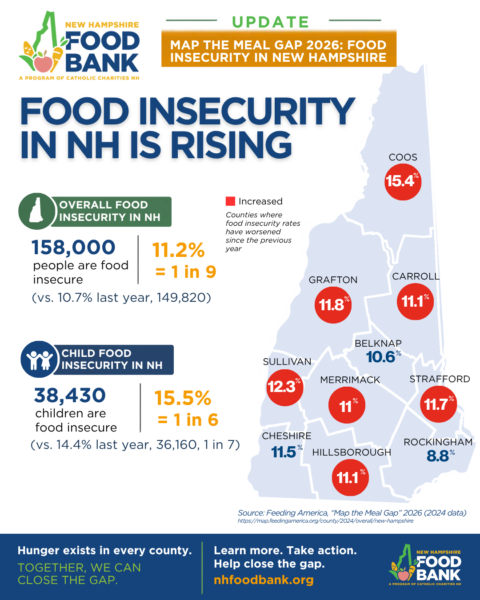
Photo Caption: Food insecurity rates continue to increase throughout the state, with children among the most impacted. In just one year, the rate of child food insecurity increased from one in seven children to one in six.
About the New Hampshire Food Bank
The New Hampshire Food Bank, a program of Catholic Charities New Hampshire, has been working to relieve hunger in the Granite State since 1984. In 2025, as the state’s only food bank, the New Hampshire Food Bank efficiently procured and distributed more than 20 million pounds of food to people experiencing hunger through more than 400 partner agencies. Agencies include food pantries, neighborhood centers, low-income housing sites, senior nutrition centers, family crisis centers, hospices, soup kitchens, emergency shelters, after school programs and day care centers.
In addition to food distribution, the NH Food Bank leads innovative programming that helps fight the root causes of hunger by empowering people to learn new skills, enabling them to become more self-sufficient.
For more information about the New Hampshire Food Bank, please visit https://nhfoodbank.org/. Find us on Facebook and follow us on Instagram, and LinkedIn.